

Why do we need to know he is sudanese?
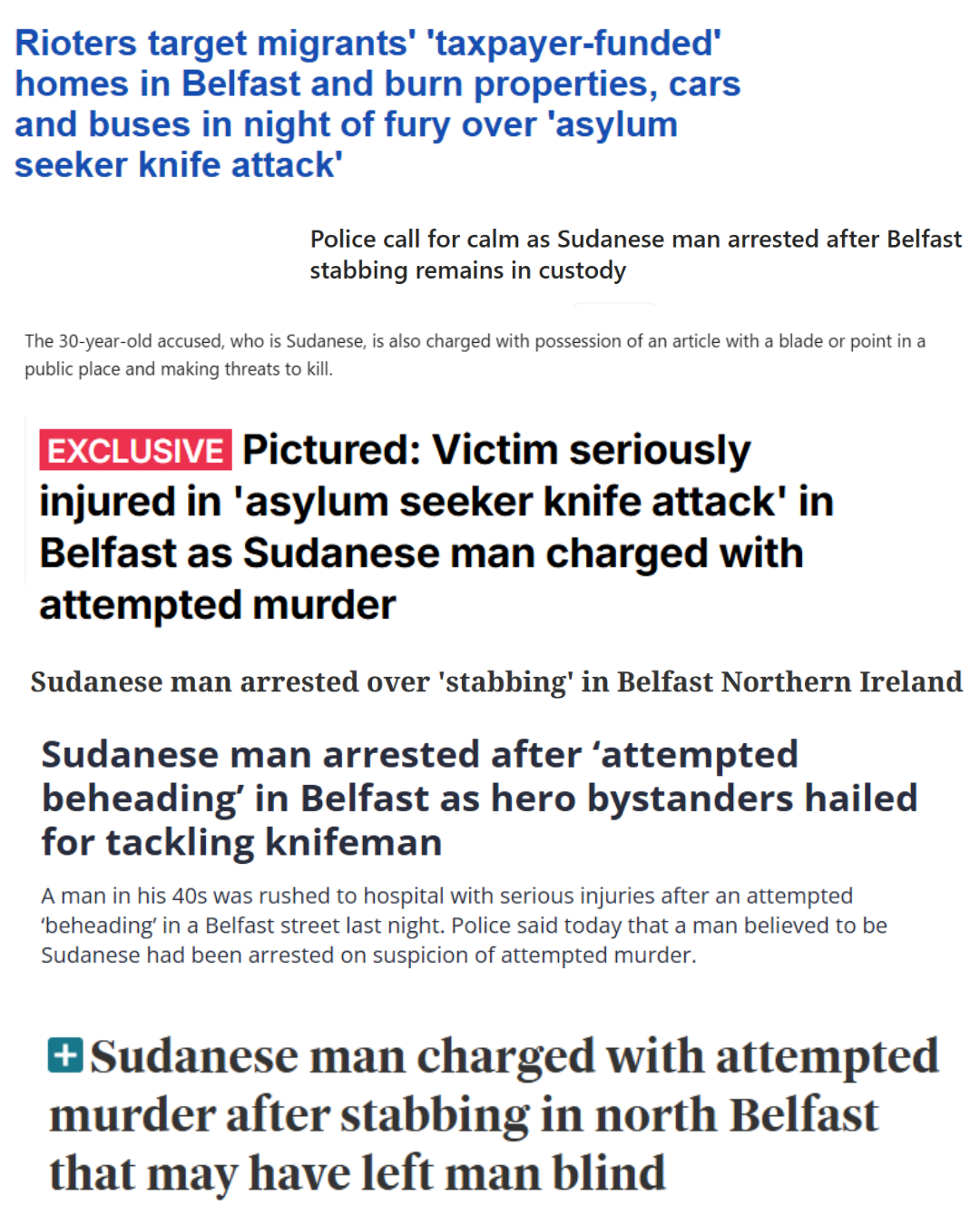
Like many people over the past few days, I've been following the coverage of the horrific stabbing in Belfast, where a man in his 40s sustained serious injuries to his eyes, face, neck and back.
It's an awful situation. A man suffered serious injuries, and there are important questions for the police and the courts to answer in the weeks ahead.
But as I read article after article covering the incident, I found myself becoming increasingly distracted by something else.
Not the details of the attack itself.
The way the story was being told.
Across a number of newspapers, readers were repeatedly told that the suspect was Sudanese. Some reports focused on his immigration status. Others referred to him as a migrant or asylum seeker. In many cases, these details appeared prominently in headlines and opening paragraphs, making them one of the first things readers learned about the story.
And that raises an important question.
Why?
I am not suggesting journalists should hide facts, that's not my point at all. Journalists have a duty to report accurately and fairly. If a person's nationality is genuinely relevant to understanding a story, then there may well be a legitimate reason to include it.
The question isn't whether the information is true.
The question is whether it is necessary and, perhaps more importantly, whether it is being presented in the public interest.
The phrase "public interest" is one that appears frequently in discussions about journalism. It is often used to justify the publication of information that might otherwise be considered intrusive, sensitive or controversial. But public interest journalism should do more than simply attract attention. It should help people better understand an issue.
That's where I begin to wonder whether some of the reporting around this case has fallen short.
If nationality is being highlighted because it is considered important for readers to know, then surely readers should also be given the wider context that helps them understand what that information actually means.
Research from the Migration Observatory at the University of Oxford paints a much more complex picture than many people might expect. According to its analysis, non-UK citizens accounted for around 13% of convictions in England and Wales and 12.4% of the prison population, figures that broadly reflect their share of the population. When researchers adjusted for age and sex, non-UK citizens were actually slightly underrepresented in the prison population compared with UK citizens.
In other words, the available evidence does not support the broad assumption that migrants as a group are more likely to commit crimes than British citizens.
That doesn't excuse crime.
It doesn't diminish the seriousness of this case.
And it certainly doesn't mean nationality can never be relevant.
But it does raise another question.
If newspapers believe a suspect's nationality is important enough to feature prominently in a headline, shouldn't readers also be given the wider context that helps them interpret that information?
Without context, facts can sometimes create impressions that are not entirely accurate.
Most people don't read every article from beginning to end. They skim headlines while scrolling through social media, catch snippets of information on their phones, or see a story shared by a friend. What often stays with them isn't the full detail of the case but the information that is repeated most frequently.
And when a person's nationality becomes one of the defining features of a news story, it is fair to ask what impression that leaves behind.
Is the public being encouraged to think about the actions of one individual?
Or are they being encouraged, consciously or otherwise, to associate those actions with a wider group of people?
This is where media ethics becomes important.
The Editors' Code of Practice, which much of the UK's press claims to abide by, states that certain personal characteristics should only be included when they are genuinely relevant to a story. Clause 12 specifically warns against unnecessary references to characteristics such as race, religion, sex, disability and other protected attributes, where this is not the case.
While nationality is not specifically listed, the principle behind the clause is clear: journalists should think carefully before highlighting characteristics that risk encouraging readers to make assumptions about whole groups rather than individuals, and only do so where there is relevance. Given the fact there appears to be no evidence-based link between nationality or citizenship background and crime, where is the relevance in this case?
The code doesn't ask journalists to avoid facts.
It asks them to think carefully about relevance, fairness and the impact of what they publish.
That seems particularly important when reporting on issues such as immigration, where public opinion is often shaped as much by emotion as it is by evidence.
Editors know that certain words attract attention. They know that immigration is one of the most politically charged topics in modern Britain. They know that references to nationality, asylum status and migration generate strong reactions online.
That doesn't mean journalists are acting with bad intentions.
But it does mean we should be willing to ask whether those details are being highlighted because they genuinely help readers understand a story or because they make the story more emotionally charged, more controversial and ultimately more clickable.
Of course, newspapers do not control how readers react to a story, and they cannot be held responsible for every act of hostility or violence that follows public outrage. Individuals are responsible for their own actions.
At the same time, it would be naïve to pretend that language has no influence at all. Headlines are carefully crafted for a reason. News organisations know that the way a story is framed affects how it is received.
The issue isn't whether crimes should be reported. They absolutely should be.
The issue isn't whether relevant facts should be published. They absolutely should be.
The issue is whether readers are being given enough information to understand those facts properly.
Because public interest journalism should leave the public better informed, not simply more emotionally invested.
At the Press Justice Project, we believe journalism plays a vital role in a democratic society. A free press matters. Investigative reporting matters. Holding power to account matters.
But responsible journalism matters too.
Perhaps the question we should all ask ourselves when reading crime reports is a simple one.
If this person's nationality had been different, would it still have appeared in the headline?
And if nationality is considered important enough to tell us, are we also being given the wider context needed to understand it, and its relevance properly presented?
Those aren't questions about censorship.
They are questions about fairness, balance and journalistic responsibility.
And in an age where headlines travel faster than facts, they are questions worth asking.