

If journalism had only one rule, it would be to always strive to report the truth. Yet the Daily Telegraph often treats accuracy as an optional extra in its reporting, rather than as the essential standard that its readers expect and depend on.
The Telegraph is a member of IPSO, the press complaints-handling body that operates the Editors’ Code of Practice. Clause 1 of the Code requires that “the press must take care not to publish inaccurate, misleading or distorted information”. Despite this very basic expectation for accuracy being front-and-centre of press standards, the Telegraph has routinely published significant inaccuracies in numerous articles across its print editions and news website.
A pattern of inaccuracies and falsehoods
Between October 2024 and November 2026, IPSO investigated 436 public complaints against 144 different newspapers. The Telegraph accounted for 49 of these complaints, all but two of which referenced Clause 1 of the Editors’ Code. Or to put it another way: more than 1 in 10 of all IPSO investigations over a 2-year period concerned claims of inaccurate coverage by the Telegraph alone.
IPSO ruled that the Telegraph had breached the Editors’ Code in over half of these cases, resulting in the Telegraph accounting for 1 in 6 of all complaints upheld by IPSO over the last 48 months.
These cases were not about trivial points of fact; they involved glaring falsehoods and misleading reporting by the Telegraph on migration, climate change, tax policies, crime and healthcare. Taken together, the Telegraph’s coverage reveals a pattern of failing standards and editorial carelessness, one with serious consequences for readers’ understanding of major public debates and for public trust in the press.
Bogus tax stats
“50,000 more Britons flee country each year under Labour” (3 March 2026) – This online article falsely claimed that UK emigration had “surged” because of “a series of punishing tax rises and a crackdown on non-doms”. In truth, the forecast ‘rise’ was due to a change in ONS methodology, and not due to any evidenced increase in the number of people emigrating. IPSO ordered the Telegraph to correct this baseless report, ruling that the paper “had not taken care not to publish misleading information” and that its headline had been “significantly misleading”.
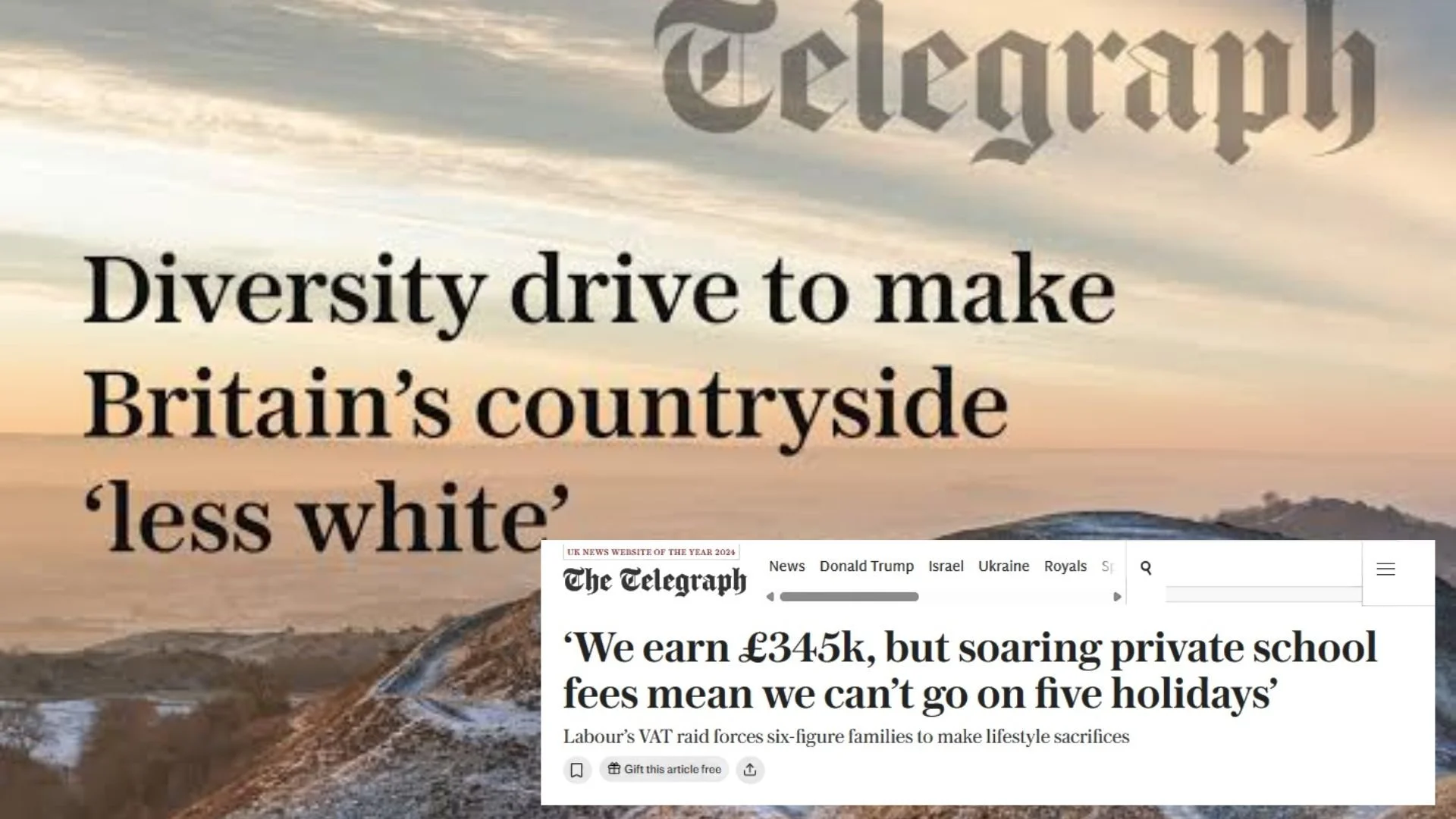
“We earn £345k, but soaring private school fees mean we can’t go on five holidays” (25 May 2025) – The Telegraph website featured claims from a named family apparently impacted by the introduction of VAT on private school fees, yet it was quickly apparent that many of the details in the story – and even the family’s existence – could not be verified. IPSO ruled that the Telegraph “had not provided any evidence of adequate pre-publication checks”, noting that the paper’s earlier apology upon deleting the article did not correct the record or meaningfully account for why the Telegraph had made such a basic editorial failure.
“Labour’s war on wealth will bring disaster to Britain this winter” (4 October 2026) –Throughout the last two years, the Telegraph has published numerous misleading articles – using findings from a report by a private wealth consultancy – claiming Government changes in tax policies have directly led to an ‘exodus’ of wealthy individuals and their assets from the UK. An extensive review by Tax Justice UK has debunked these inaccurate reports, and the campaign has demanded IPSO investigate systemic standards failures in economic reporting by the press.
Fudging the numbers on migration
“One in 12 in London is illegal migrant” (23 January 2025) – This false statistic was featured as a front-page headline of the Telegraph’s print edition, and repeated in follow-up reports and commentary pieces. This claim was based on a miscalculated interpretation of population estimates by Thames Water, which did not support the ‘one in 12’ figure. IPSO ruled that the Telegraph had failed to take necessary care in publishing accurate figures, and misleadingly presented ‘one in 12’ as a definitive figure.
“One Albanian migrant being jailed every two days” (8 April 2026) – This article had two distinct complaints upheld against it, both for wildly misleading misuse of statistics on migration. The piece falsely claimed that the cost of imprisoning 63 Albanian migrants would be “nearly £800 million”, while the actual cost is estimated as closer to £12.7 million. The article also falsely reported that Albanian prisoners “account for nine per cent of all inmates in British prisons”, when in reality their proportion of the total prison population is just 1%.
“More than one million foreign nationals are receiving benefits” (17 March 2025) – The Telegraph reported on figures, based on “analysis by the Centre for Migration Control”, claiming that DWP records showed that 1,150,000 “foreign nationals” were in receipt of universal credit. Yet the data used by DWP only refers to the nationality of claimants at the time of their registration for National Insurance, and not at the time they received benefits. Neither the original CMC analysis, nor the Telegraph’s reporting of it, had meaningfully accounted for this distinction, and IPSO ruled that the article “presented the figures as fact, rather than an interpretation”.
Extreme weather and climate change
“Fall in weather delays erodes rail chief alert” (4 April 2026) – An article claimed that the number of weather-related train delays had fallen since 2020-21, contrasting this with a statement from the head of Network Rail who has said that “climate change is the biggest issue faced by the railways”. In truth, the absolute number of weather-related delays had increased over that period, while their share of total rail journeys affected had decreased. Although the Telegraph referenced this distinction much later in the article, IPSO ruled that the prominent claims made in the headline and opening sections amounted to significantly inaccurate reporting.
Omissions and distortions
Over the last two years the Telegraph has also published numerous articles featuring falsehoods and distortions, either through false inference or omission of essential context, including:
A November 2025 piece headlined “Watchdog keeps Covid vaccine death data secret” falsely implied that private data was being withheld in case it “could link Covid vaccines to excess deaths”.
A January 2026 article misleadingly implied a prisoner had won a High Court case “because he was depressed”, when the ruling related to the Ministry of Justice subjecting him to unlawful conditions.
“Most successful Muslim channel in UK faces Ofcom investigation”, a March 2025 article that falsely suggested The Islam Channel faced a formal standards investigation by Ofcom.
“Two men a day have trans surgery on NHS”, a May 2025 article that inaccurately reported “a large proportion” of patients referred for gender-affirming surgery “are under 18”, despite such surgery not being available to under-18s.
“Diversity drive to make Britain’s countryside ‘less white”, a February 2026 piece misquoting from a Government report that considered how to encourage ethnic minorities to visit national parks.
Time for the Telegraph to face proper scrutiny
What stands out from the above reports is that the Telegraph’s many errors always lean in the same direction: against immigrants, against climate change, against medical science, and against minorities. Readers might expect the occasional error and inaccuracy that isn’t linked to the Telegraph’s long-standing editorial line about a ‘failing society’. Instead, we have to question whether this sad catalogue of falsehoods and misleading reporting represents genuine mistakes. IPSO has the power to investigate serious and systemic failures by newspapers to abide by basic journalistic standards – it is long past time the Telegraph faced serious regulatory scrutiny.