

Ethical Reporting Guidelines Launch
Press Justice Project | Cardiff University School of Journalism | 23 April 2026
“A free press is the most watchful sentry of the state. A ‘yes’ press is fatal to good government.” — Tom Hopkinson, founder of Cardiff University School of Journalism
There could hardly have been a more fitting place to launch the Press Justice Project’s Ethical Reporting Guidelines.
Last week, at Cardiff University’s School of Journalism, those words set the tone for an evening focused not on abstract debates about the media, but on its real-world impact.
Reporting Shapes Outcomes
In her opening presentation, Press Justice Project Coordinator Liz Pendleton set out the focus of the first edition of the guidelines: three areas where reporting has profound, measurable consequences. Across each of these topics, the role of the media carries enormous weight and responsibility.
On The Climate and Nature Crisis, the scientific and economic evidence is clear. Yet coverage can still downplay urgency or fragment understanding, slowing the public response to an escalating threat.
On Domestic Abuse and Gender Based Violence, reporting can reinforce harmful narratives - normalising abuse, entrenching stigma and perpetuating victim-blaming. Conversely it can instead challenge myths, support survivors, and strengthen accountability.
On Mental Health and Suicide, the impact is starkly evidenced. Irresponsible reporting has been linked to increases in suicide rates of 10–30% - the “Werther effect” Whereas careful, evidence-based reporting can instead encourage help-seeking and reduce harm - the “Papageno effect”.
These are distinct issues, but they share common ground: complexity, frequency of coverage, and life-or-death real-world consequences. Despite the depth of expertise available, reporting does not always reflect what is known, and the number of victims of press wrongdoing keeps increasing.
From insight to intervention
Before this project began, the Press Justice Project examined the existing landscape of ethical reporting guidance.
Through its work supporting victims of press harm, we already understand where reporting falls short - and the very real impact that can have on individuals and communities. What became clear through our assessment of guidelines and standards was that there was not a lack of expertise, but a gap in how that expertise translates into practice.
There is a wealth of high-quality guidance. Civil society organisations and subject experts have developed detailed, thoughtful frameworks across these topics - often running to dozens of pages. But these resources are often long and detailed reading, spread across many organisations and platforms, requiring time to locate, interpret and apply.
In a fast-paced newsroom, that creates a practical barrier.
The Ethical Reporting Guidelines respond to that challenge - bringing together existing expertise and distilling it into a format that is concise, accessible and usable in real reporting conditions.
Designed with use in mind
The physical setup of the launch reflected the careful thinking behind the guidelines.
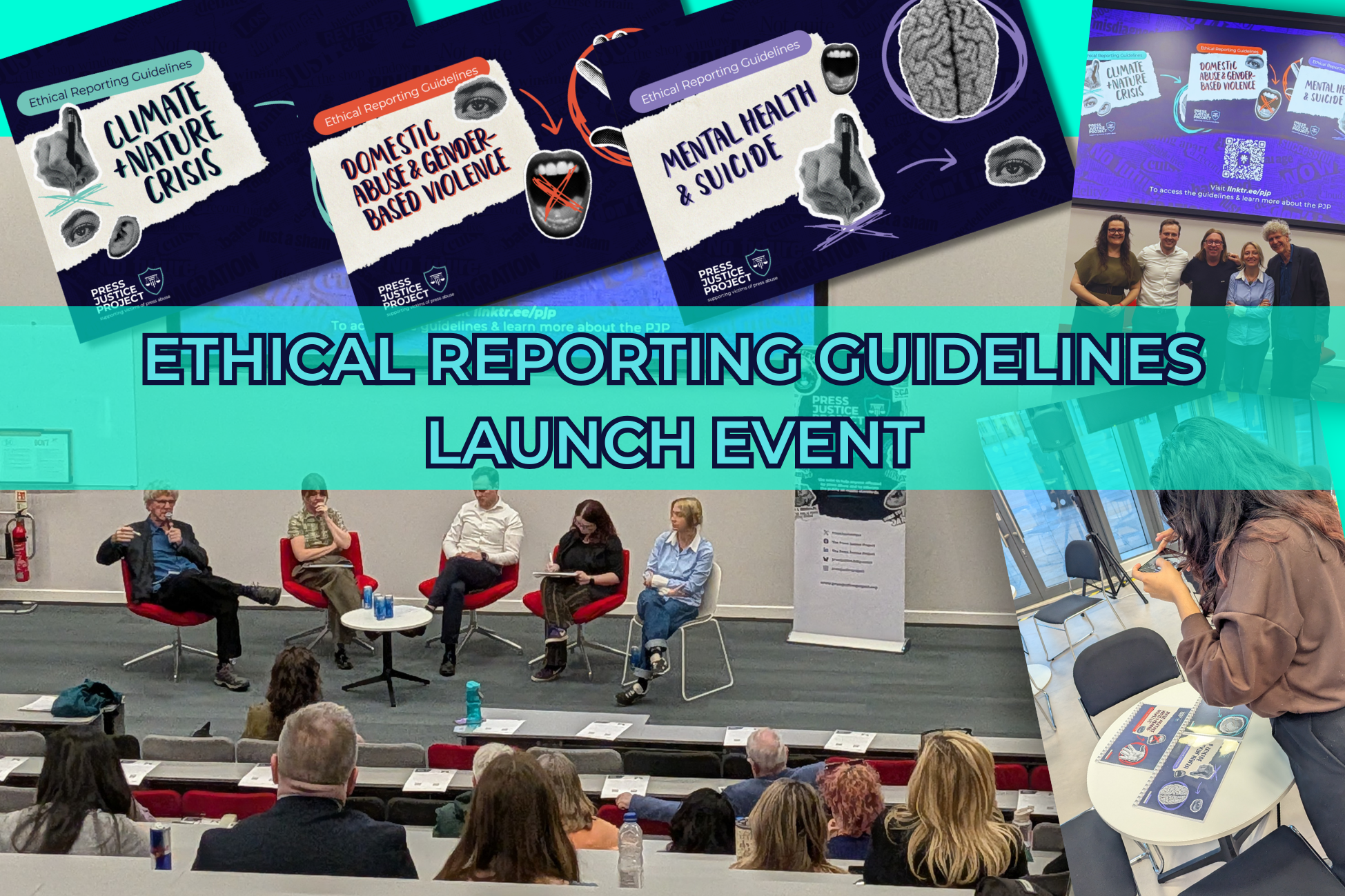
The lecture hall hosted a gallery of A2 printed versions, allowing attendees to engage with them in full.
Sample print copies were also available on display, however, the guidelines have been carefully designed for digital-first use - with an A4 landscape format that mirrors how journalists typically work on laptop screens and computer monitors, and with the content also being immediately accessible via this web page - in a mobile-friendly view. This also means that no pdf downloads are necessary to view the guidelines but are available for those who want to keep a copy of them offline.
Every element, from content, layout, graphic design and presentation, has been carefully shaped with usability in mind: something that can be quickly referenced, easily navigated, and applied in the moment decisions are made.
A shared conversation
The launch of the guidelines was followed by a panel discussion and audience Q&A, chaired by Press Justice Project Director Nathan Sparkes, bringing together perspectives from across journalism, regulation and civil society:
Emma Jones – experienced national journalist, offering insight into reporting under newsroom pressure
Professor Steven Barnett – Professor of Communications at the University of Westminster, whose research focuses on the relationship between media, democracy and public policy
Liz Smith – lead on advocacy and policy at Wales Environment Link, a network of environmental charities
Lexie Kirkconnell-Kawana – Chief Executive of IMPRESS, the independent press regulator
The discussion explored the realities of modern reporting, the structural pressures within the media, and the role that practical, accessible guidance can play in improving standards.
What happens next
The launch marks the completion of an important first phase, as well as the beginning of a broader programme of work.
Next steps include:
Direct distribution of the guidelines to newsrooms across the UK, including printed formats for editorial desks
Engagement with regulators and industry bodies
A Welsh-language edition for media organisations across Wales
Integration into journalism education and training
Ongoing collaboration with civil society organisations and people with lived experience
The development of further guidelines covering additional subject areas
Alongside this, the Press Justice Project will continue to facilitate dialogue between the public, those affected by press malpractice, and the media itself.
The ambition is to build a comprehensive, evolving resource — a place where journalists can access trusted guidance quickly, and where standards are continually strengthened over time.
Raising the standard
At its core, this work connects three things: expertise, lived experience, and practice.
When the impact of reporting is understood — and when better approaches are clearly available — expectations change. Ethical reporting becomes part of a shared responsibility, grounded in knowledge of its consequences.
On issues such as suicide, domestic abuse, and the climate crisis, the way stories are told can influence understanding, behaviour and outcomes.
Improving reporting in these areas is not abstract. It is practical, necessary, and overdue.
With thanks to all contributors, including;
* White Ribbon - A global movement working to engage men and boys in ending violence against women and girls. It focuses on prevention through education, awareness-raising and cultural change.
* Refuge - The UK’s largest specialist domestic abuse organisation, providing life saving support to women and children experiencing domestic violence and other forms of gender based violence.
* Friends of the Earth - A leading environmental and climate justice organisation working in the UK and Internationally to address climate breakdown, biodiversity loss and environmental inequality.
* Wildlife & Countryside Link - The largest environment and wildlife coalition in England bringing together more than 80 conservation, environmental and animal welfare organisations.
With thanks to our expert reviewers including;
Richard Ayre, a former BBC journalist and senior media executive, specialising in editorial standards and media regulation.
Professor Chris Frost, Emeritus Professor of Journalism at Liverpool John Moores University with over 40 years experience as a journalist.
Dr Sara Torsner, a research fellow in the School of Information, Journalism and Communication at the University of Sheffield. Subi Shah, an award winning freelance journalist and newsroom editor working across broadcast and print media including BBC World Service News and New Internationalist.Andy Extance, a Science journalist and former Chair of the Association of British Science Writers.
Caroline Moberg, a Senior Ad Policy Specialist at Snapchat going on 7 years, she focuses on developing and refining advertising policies particularly for sensitive categories.
Dr Aaron Thierry, a climate scientist and researcher based at Cardiff University, specialising in climate change communication and public understanding of climate science.
and to the Waterloo Foundation for their generous support in making this work possible.
With special thanks to the hard work on creating existing guidelines which heavily inspired this work, from dozens of civil society organisations across the UK..
Note: Version 1.0 covers three initial areas — climate and nature, domestic abuse and gender-based violence, and mental health and suicide — with plans to expand into further topics over time.
The guidelines are also designed to be accessible beyond journalism. For individuals who have experienced harmful reporting, they offer a clear reference point — a way of understanding what ethical reporting should look like, and where it has fallen short.
If you would like to be part of the project, if you have any questions or feedback on the guidelines we would love to hear from you, please email info@pressjusticeproject.org.